Use action-free demos
Successful videos carry task-level physical priors even without robot action labels or a matched embodiment.
Common Outcome Regularities from Action-Free Visual Demonstrations for Robot Manipulation
1 Peking University, Shenzhen Graduate School, Shenzhen, China
CORE turns successful terminal observations into concrete, reusable visual conditions. The robot is not asked to imitate human actions; it learns to pursue the visual regularities that successful outcomes share.
Robot imitation learning often relies on expensive robot demonstrations. Meanwhile, abundant human or action-free videos are difficult to use directly because they lack robot-executable actions and may differ strongly in embodiment.
CORE addresses this gap by learning Common Outcome Regularities: stable object configurations, spatial relations, and contact constraints that define successful completion. These learned representations are distilled into visual goal prototypes and injected into robot policy backbones.
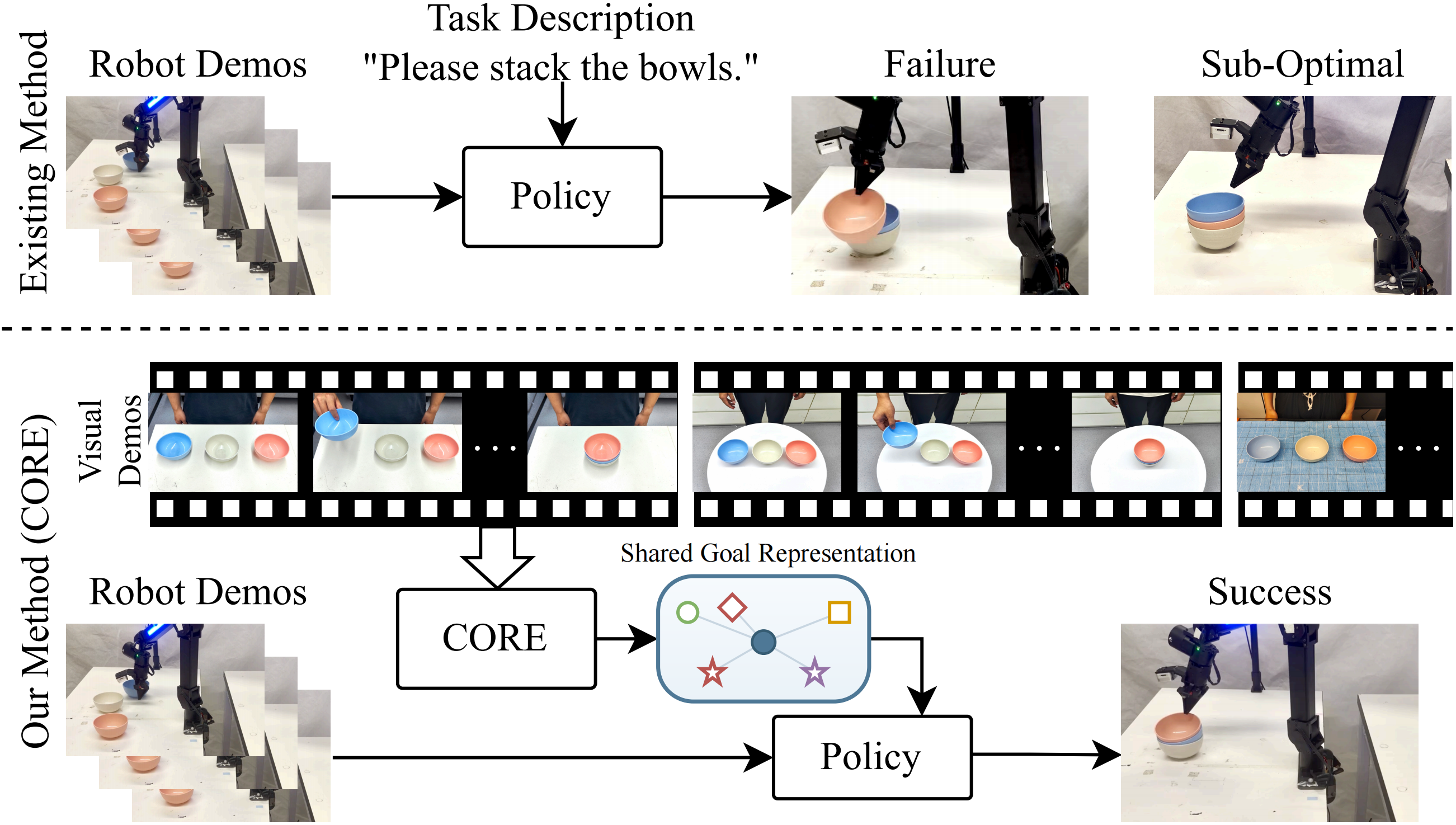
Figure 1 - Why outcomes? Language instructions give high-level task intent but can omit geometry, pose, contact, and terminal-state constraints. CORE learns visual goal prototypes from successful terminal states and uses them to guide execution.
The method keeps what is essential to task success and sidesteps what cannot be transferred across bodies, cameras, and action spaces.
Successful videos carry task-level physical priors even without robot action labels or a matched embodiment.
CORE concentrates representation learning on terminal states, making shared object configurations and contact relations explicit.
A compact goal-conditioning module augments established policy families with concrete visual goal features.
CORE converts successful terminal observations into task-level visual goal prototypes, then conditions the robot policy on both its current outcome embedding and the desired prototype.
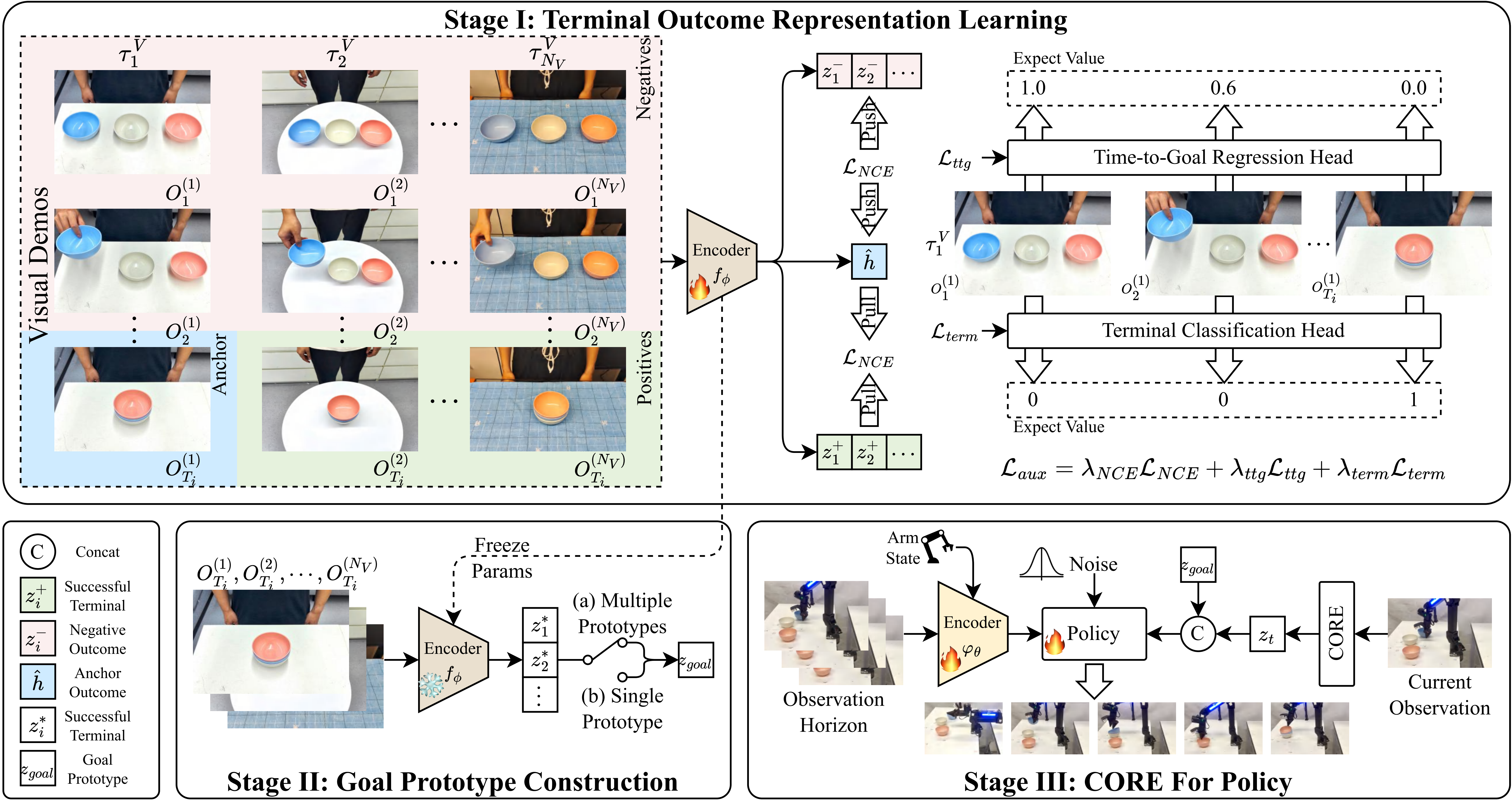
Figure 2 - CORE pipeline. A terminal outcome encoder is trained first; successful embeddings are then aggregated into goal prototypes; finally, the policy uses the outcome feature and prototype together for action generation.
Contrastive sampling pulls successful terminal outcomes together and separates non-terminal or task-negative observations.
Successful terminal embeddings are aggregated into robust task-level prototypes with K-Means and Top-K averaging.
The policy receives a joint condition composed of the current outcome embedding and the static visual goal prototype.
Average success rate (%) reported in the paper. CORE consistently improves its matching backbone and outperforms frozen text-conditioning in the evaluated settings.
| Benchmark | DP3 | DP3 + Text | DP3 + CORE | MP1 | MP1 + Text | MP1 + CORE |
|---|---|---|---|---|---|---|
| Meta-World | 81.5 | 81.9 | 84.0 (+2.5) | 81.7 | 81.4 | 85.6 (+3.9) |
| RoboTwin 2.0 | 77.5 | 77.4 | 82.3 (+4.8) | 68.3 | 69.7 | 79.4 (+11.1) |
| Real World | 65.0 | 68.0 | 82.0 (+17.0) | 69.0 | 67.0 | 85.0 (+16.0) |
Each component contributes to a representation of task completion that is both discriminative and useful for policy control.
On Meta-World Hard and Very Hard tasks, MP1 + CORE reaches 71.7 average success versus 64.2 for MP1.
Top-K construction reaches 71.7 average success, outperforming random terminal selection and a single mean prototype.
Across four tasks, CORE + DP3 averages 79.8 versus 59.2 for Uni3D + DP3, showing that terminal outcome learning is central.
The paper examines more than the final average: CORE improves optimization behavior, benefits from additional action-free visual data, and outperforms a frozen general-purpose visual encoder.
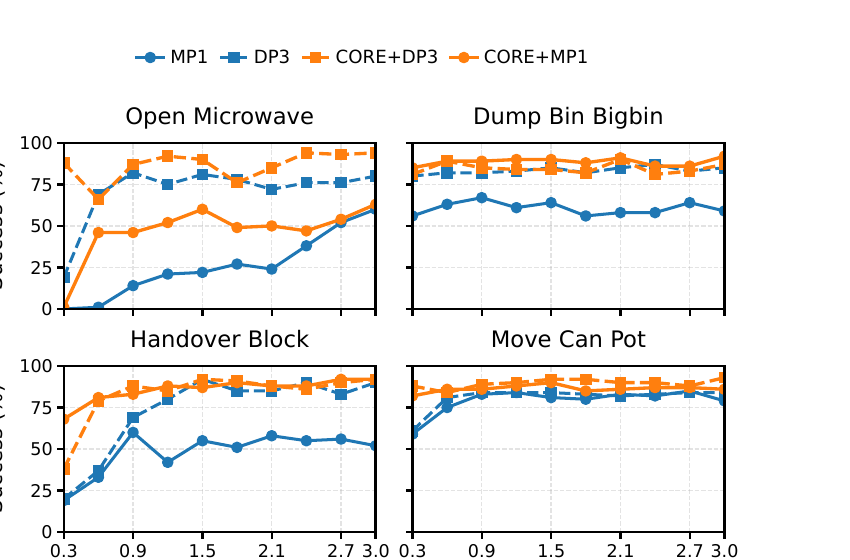
Across representative RoboTwin 2.0 tasks, CORE-integrated DP3 and MP1 policies sustain stronger success rates as training progresses.
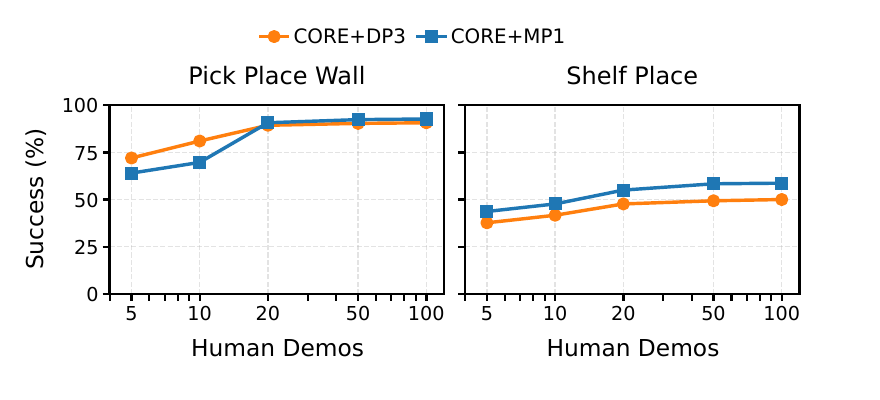
Performance rises as action-free human demonstrations grow from 5 to 100, with early stabilization on Pick Place Wall.
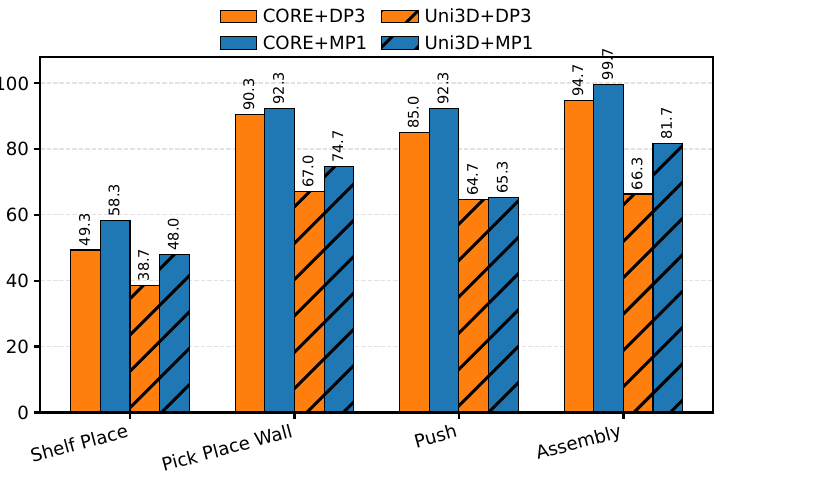
On four tasks, CORE + DP3 reaches 79.8% versus 59.2% for Uni3D + DP3; CORE + MP1 reaches 85.7% versus 67.4%.
Each row shows the same task: a visual demonstration, a policy baseline, and the result conditioned on a learned CORE prototype.
Action-free evidence of the completed state.
Can stop short of the desired terminal state.
Guided by the learned outcome prototype.
The terminal structure defines completion.
Final-state details remain under-specified.
Goal prototypes guide successful completion.
Action-free evidence of the target bottle arrangement.
The learned visual goal condition guides the final adjustment.
Action-free video captures the task's terminal structure.
CORE conditions the policy toward a successful contact-rich outcome.
Shared evidence of a nested terminal configuration.
A contact-rich task with precise terminal constraints.
Outcome conditioning guides the final arrangement.
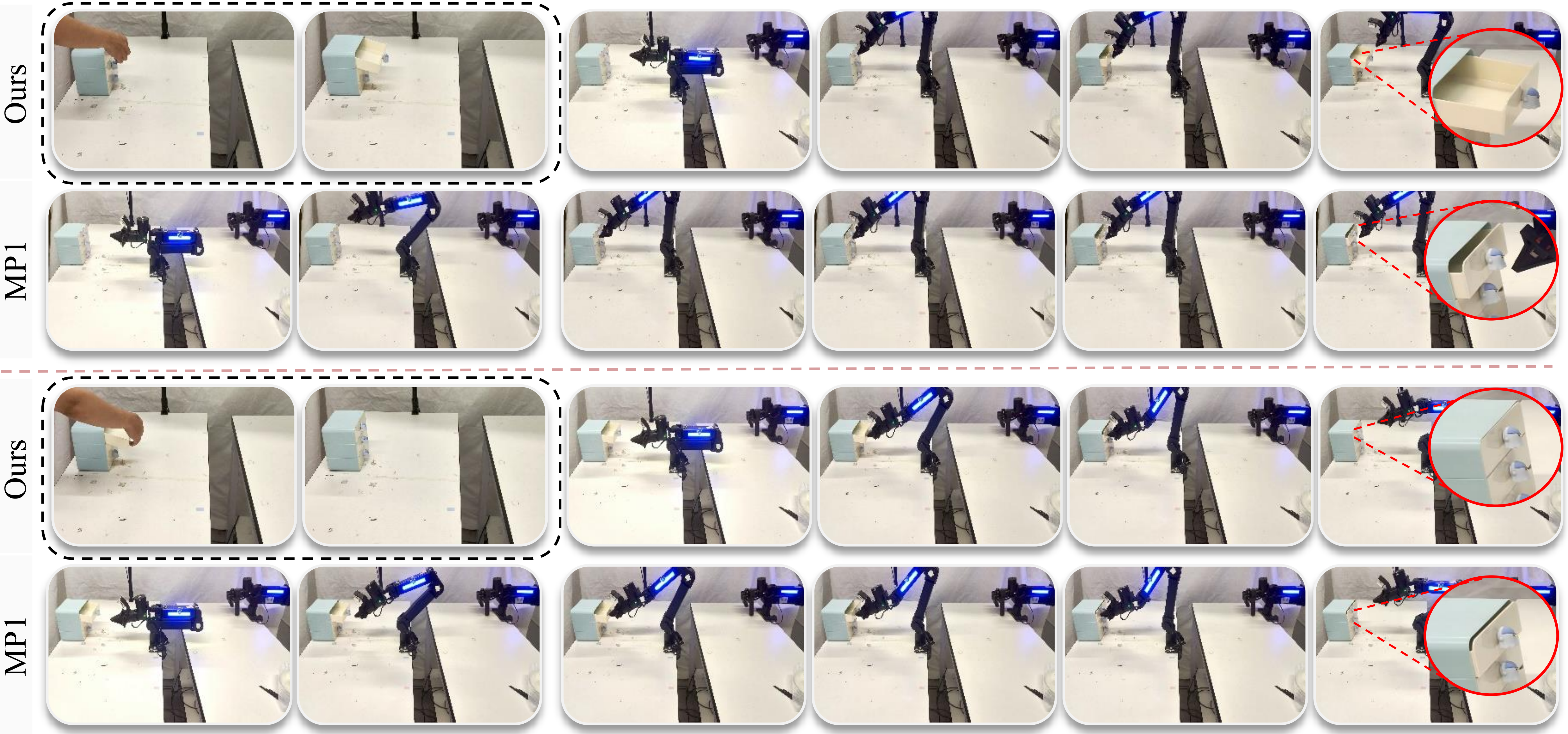
Figure 3 - Qualitative comparison. On Open Drawer and Close Drawer, CORE reaches target terminal states more reliably than MP1 in the shown cases.
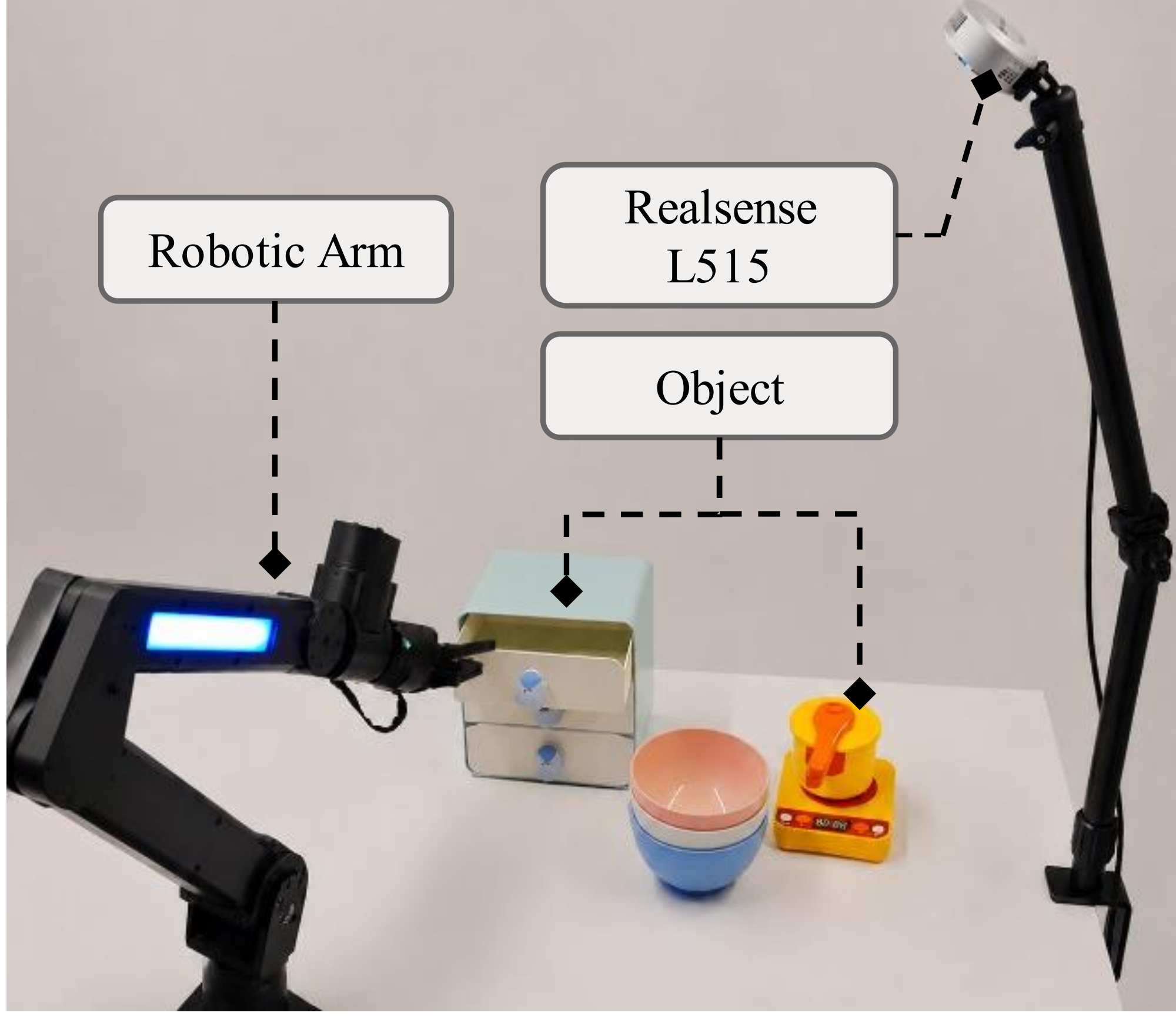
Real-world setup. Five contact-rich tasks are evaluated using 100 robot demonstrations and 50 action-free human demonstrations per task.
CORE improves policy outcomes across multiple contact-rich real-world manipulation tasks.
| Method | Adj. Bottle | Cook | Close Drawer | Open Drawer | Stack3 | Average |
|---|---|---|---|---|---|---|
| DP3 | 60 | 80 | 65 | 45 | 75 | 65.0 |
| MP1 | 70 | 75 | 70 | 55 | 75 | 69.0 |
| DP3 + Text | 60 | 80 | 75 | 50 | 75 | 68.0 |
| MP1 + Text | 65 | 80 | 70 | 50 | 70 | 67.0 |
| DP3 + CORE | 75 | 95 | 85 | 70 | 85 | 82.0 |
| MP1 + CORE | 85 | 90 | 90 | 75 | 85 | 85.0 |
If CORE is useful for your work, please cite the arXiv paper and explore the implementation.
@misc{sheng2026core,
  title  = {CORE: Common Outcome Regularities from Action-Free Visual
            Demonstrations for Robot Manipulation},
  author = {Sheng, Juyi and Tan, Mingxin and Li, Jincheng and Liu, Mengyuan},
  year   = {2026},
  note   = {arXiv:2606.29517},
  url    = {https://arxiv.org/abs/2606.29517}
}